%20Cropped.png)
Customer Personas for Startups: How to Find Your Maximum Valuable Segment™


Validation is the key determinant of whether a startup is successful.
Too many people think it is the idea, a polished deck, or how good the product is.
But at the early stages, all of these are hypotheticals until you get close enough to real customers to find out what is actually true.
And the scary truth along with it:
whether your idea is worth pursuing.
And I’ll be the first to admit it:
“validation” as a definition and a concept is incredibly vague.
Like trying to catch Moby Dick, validation appears to be this elusive, ephemeral thing that early-stage founders seek, while agencies claim to know the secret to obtaining it.
For me, there are different types of validation.
And while I will provide my definition, I will also show you my frameworks — methods I’ve worked through with hundreds of startup founders and their businesses, taking them from idea to launch to revenue, with speed.
But for now?
Validation starts somewhere simple but unglamorous...
The first step to validation
Validation starts with knowing exactly who you are building for, in enough detail that you could not only picture that person, but spot them when they walk into a room.
That is what a customer persona for an early-stage startup is supposed to be.
And unfortunately, most of the ones I see are not that; which is why most founders ignore the exercise or treat creating customer personas as a form of busy-work — because done incorrectly, that is all it is.
This is the version that works.
I know this because I’ve applied it again and again and again with launching my own businesses and with hundreds of startup founders.
And it ends at a destination that I call your Maximum Valuable Segment™: the one customer group worth building your entire go-to-market around when you launch.
Everything in between is a system for turning what you assume into what you know.
But first…
You are right to be sceptical
I used to think customer personas were bullsh!t.
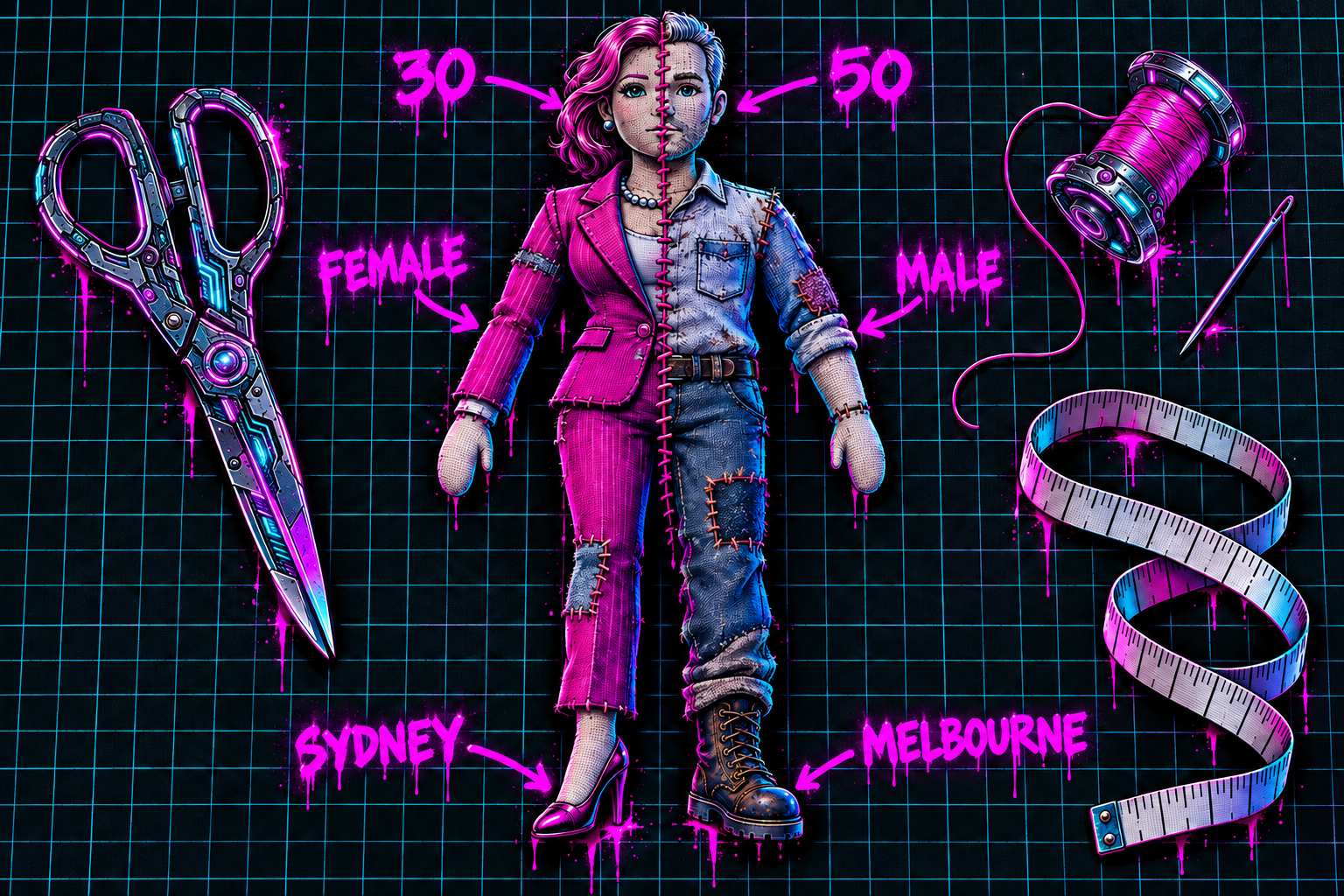
Management consultants and ad agencies threw the term around, and I had seen the nonsense they handed over. These monstrosities that I can only describe as vague Frankenstein human hybrids appeared in pitch decks and business plans.
They’re all:
- thirty to fifty years old
- male and female
- living in major cities, and
- they all happen to need your product.
So to set the record straight:
There is no such thing as a male-female between the ages of thirty and fifty who lives in Melbourne and Sydney, earns between $80,000 and $150,000, and likes long walks on the beach.
That is not a persona.
That is a made up bit of nonsense, and it is genuinely unhelpful.
Here is the problem with it:
The bad version cannot be wrong, which means it can never be right.
Startups are built on hypotheticals and experiments.
And when something is vague, it cannot be tested.
You could run those personas past one hundred real customers and they would survive all one hundred conversations unchanged and unchallenged, simply, because they do not claim anything.
Just like you will never truly feel accomplished achieving a general goal (”get stronger”), you will never truly be able to target a general persona.
If an agency ever hands you one of these vague Frankenstein human hybrids.
Put it where it belongs…
In the bin.
And don’t hesitate to stuff the agency in there too.
Vague Frankenstein human hybrids are busywork exercises made for big agencies serving big customers.
And they exist because the outcome of their work does not determine whether the business lives or dies.
As a startup, you do not have that privilege.
It’s also a clear signal they don’t truly know the customer.
They know a vague segment of what the customer likely looks like.
So yes, you have the right to be sceptical about personas.
Because so was I.
Until I realised the direction was correct, but the tool was blunt.
Correctly sharpened for a startup, I watched properly built personas help scale a company from 500 customers to over 40,000. Here’s how…
What a real one looks like
A persona needs to be specific.
(If you take one thing from this whole playbook, take that.)
Specific across demographics: age, sex, location, profession, income and budget.
And, specific across psychographics: interests, activities, opinions, behaviours, values, beliefs and lifestyle.
The coffee test.
If you cannot picture your persona as a real, specific person, someone you could actually take for a coffee, then you do not have one yet.

By specific, I mean:
- 43 years old (not thirty to fifty)
- They earn $127,000 a year
- You know their exact job title
- You know the suburb they live in, not the city or the state
- You know what they do on a Saturday
- What annoys them
- What they have already tried and
- What they have abandoned
Each persona sees the problem slightly differently, has a different budget, and plays in a different place.
The dinner party test.
Once you have written three to six of them, they should be distinct enough that you could seat them at a table together in your mind.
They all arrive with different personalities, different clothes, different values, different wants and different desires.
One arrives too early.
One is fashionably late.
And one does most of the talking after one too many wines…

But that’s not the point.
The point is:
You should be able to raise a new feature or a price change at that metaphorical table and hear four different opinions, because they are from four different people.
If you cannot sit your personas at your dinner table in your mind,
they will likely never buy your product in the real world.
But let’s get out of our heads…
The specific persona skeleton
This is the part most articles leave out, so here are the actual fields.
You will not have answers for all of them on day one. That is fine and it is the point.
Fill in what you can, guess the rest, and mark the guesses (don’t worry, I’ll show you how).
Identity
Name, using the naming convention belowAge, a number, not a rangeLocation, suburb or townJob title,exactly as it appears on their email signatureIndustry, are they a student or what is their career path- Employer type and size, or business revenue / staff count if they run it
- Education, high school, tertiary, or trade school
- Income, or the revenue their business turns over
For business personas, we also add:
- Size: revenue / staff count
- And the name becomes the key contact person and/or decision-maker
Life and behaviour
- Media use:
- What do they use, consume, subscribe to and why
- What they read, watch and listen to
- Who they already trust on this subject
- Technology: savvy or not
- Recreations: What they do on a Saturday
- What success looks like to them, in their terms rather than yours
- What unique behaviours do they have
- What are they worried about
- What happens if they don’t solve this
The problem
- Their primary problem, written in their words, not yours
- Their secondary problems, what happens as a result of this problem, consider the Five Whys
- Fussy or not, when it comes to solving the problem or making decisions
- How often it happens
- What it costs them in money, time or stress
- What triggers it, meaning what happens on the day they finally decide to do something
- What they have already tried, why they stopped, and what they might be doing or using as an alternative
Your solution, from their side
- How exactly does your product address their primary problem
- What specific features support their secondary problems
- What sacrifices, changes or would they have to stop doing to use it
- What your product actually does for this person, in one sentence they would recognise
- The single reason they would say no
How they buy
- Who decides
- Who else is in the room
- Which budget bucket this comes out of, and roughly how big that bucket is
- How much are they spending on comparative alternatives
- How long a decision like this normally takes them
- What kills the deal
Where they are (their channels)
- Where they are at work: the locations (online / offline), the tools, the industry bodies, the trade publications, the groups
- Where they are at play: with family, with sports, with relaxation, and with online communities
- Who else already sells to them, which is where you find your Fishmonger™
Your verdict
- Pain: high, medium or low
- Sales velocity: high, medium or low
- Wallet share: high, medium or low
- Status: target, grey, or discarded
The last block is what turns a description into a decision, and we put it to work when we choose your Maximum Valuable Segment™ below.
But first, the easiest validation frameworks to deploy now…
Yellow, green and grey
Write the personas into your business plan or your canvas.
The first hesitation I get, every time, is some version of:
I don't know all this, do I just make it up?
Yes. Make it up. Have fun with it.
Generalise, use your gut, put something on the page.
Guessing who your customers are is not the problem. Never testing your guesses is the problem.
< GRAB A FREE PERSONA DOWNLOAD HERE>
Once you’ve detailed your personas in a template, then it’s time to run the first test, which is the easiest test in this entire playbook:
- Anything you made up, highlight yellow
- Anything you know to be true and proven, highlight green
- Any persona you are deliberately not chasing yet, grey the whole thing out
Yellow is an assumption. Green is a verified fact. Grey is parked.
Yellow / Green / Grey. That is the whole system.
It couldn’t be easier.
And it leads directly into my definition of validation:
Validation is the act of turning assumptions into verified facts.
I see this with private coaching clients constantly. The ones who make the most progress, start with a page covered in yellow, and, week after week, they chat to customers, come back, update what they got wrong, and turn a few more lines green.
It is not a feeling that you are making progress. It is a visible change on the page.
Yellow / Green / Grey is a system, and systems build businesses.
The truth detector: do you even know this market?
With private clients, this is the point where I get to do the big reveal.
Like pulling a rabbit out of the hat, it gets them every time.
But I'll let you in on the secret.
By completing this exercise you almost always reveal a simple diagnostic hiding in your personas — that if we were working together, I would always point out:
If a persona is entirely yellow, you do not know that market.
Seriously, work through your personas and if you find one is very yellow, you need to be honest with yourself about that fact.
It does not mean do not build the business, because outsiders disrupt established industries all the time. But it does mean you might have further to walk than you thought, and the evidence for that is sitting right there in the colour, because if you knew these people you would have much more green on the page.
But before we overcomplicate things, it’s worth noting…
Validation is not evaluation
It’s worth separating two things that get used interchangeably.
Plenty of good advice about early startups is really about evaluating an idea:
- Do you have the problem yourself?
- Are you passionate about it?
- Is it a painkiller rather than a vitamin?
Those are useful questions and I ask versions of them on almost every discovery call. But they are all answerable at your own desk. That makes them evaluation, not validation.
Evaluation is you assessing your idea.
Validation is external by definition.
Validation requires somebody who is not you.
And, most importantly, even if you do “eat your own dogfood”, you are not your customer.
You might represent one aspect of a persona you're building for. But your own demographics and psychographics are a sample of one, and a sample of one is not a generalisation you can build a business on.
Validation of one is not validation.
So here’s the takeaway:
Nothing turns yellow into green inside your own head. The founders who conflate evaluation with validation can spend a year feeling rigorous without ever having tested anything.
Evaluate the idea. Then go and validate it.
"Truth is confirmed by inspection and delay;
falsehood by haste and uncertainty."
- Tacitus
Where this came from
The problem: Fiestafy.
I founded my first tech startup in 2013, a business called Fiestafy that helped people find major available and accessible events anywhere in the world.
Think: Expedia for major events.
Like flights and hotels, if an event sold out, it dropped off the platform.
The clue to why I struggled for two years was sitting in my own elevator pitch.
We helped people find events. People means everyone, and when you build for everyone you build for no one.
It took the data of my personas to show me why I struggled for so long.
Because we never listed sold out or past events, the big concerts, sports games and festivals kept falling off the platform, which made them uneconomical for us to promote.
What was left, month after month, was theatre and art.
These had long seasons, repeat showings, and they never truly sold out.
What that revealed was all that was left:
The real customer was a theatre and art lover. A specific taste, not everybody.
The irony is that I am an art history major and I have been a practising artist since I was a kid. I was closer to that customer than almost anyone building in that space — I had countless friends and colleagues that fit those criteria, so I could’ve covered pages of persona attributes in green, because I knew them.
But I still had to cast a wide net, haul in a load of useless fish, and sort through the data to find the ones that would eventually build the business from Sydney to Singapore to London.

There wasn’t a light bulb, nor a lightning bolt.
That was a revelation that took almost two years.
And if I’m being honest, it probably took longer to truly refine that retrospective hindsight.
But here’s where I really saw the undeniable proof that my framework for personas can take a company from 0 to $50 million…
The proof: scale-ups.
Where personas really showed me what they were was in the next company, a VC-backed marketplace I helped scale from 500 customers to over 40,000, Sydney to San Francisco.
From the start we got specific with our personas and we named them.
Every monthly meeting we recapped our personas so the whole company knew who they were. Intimately.
What that meant for us was this:
When the Product team proposed a feature, Engineering could push back on it commercially, not just technically. You would often hear things like:
"I think this feature is great, but it really only serves Small Fry Fred.
Fred makes up about 10% of our client base and he is our lowest paying customer.
I thought we were focusing on bigger customers, like Wally the Whale?"
That is an Engineer arguing customer strategy in a sentence, without a briefing, and without anyone having to re-explain who Fred is.
The tool that became indispensable at a company worth $50 million is the one almost nobody touches at zero. That is backwards.
Everything below is a scale-up instrument applied on day one.
[EMBED THE VIDEO HERE]
Write three to six, including the ones you are not chasing
Not one. Not fifteen. Three to six.
Too many founders have personas living rent free in their heads, taking up load, never written down, never tested.
Get them out.
And if you know that eventually you will target a different or bigger customer, write those down as well, then grey them out.
There’s two reasons we do this:
- The obvious one is that the team can see where this is going.
- The one people miss is directional coherence.
Your first customer should strategically point towards your eventual customer.
If it does not, you land in one of two failure modes — and I see these all the time:
Either you build reluctantly for the customer you actually have and lose interest in your own company, or you keep building for the one you are dreaming about, who never turns up.
If you want to catch whales eventually, but you are fishing in a lake with no route to the ocean, you are never going to graduate.
Talking about fish…
Size them like fish
Small fry, bigger fish, dolphins, whales.
If you sell to businesses, ladder them by size:
- Solo operator
- 2 to 5 staff
- 5 to 20
- 20 to 50
- 50 to 250
When you are validating and launching, start with the smallest fish you can actually catch.
Unless you have the connections or a very specific offering, enterprise will not take you seriously early on.
The risk is too high for them, and honestly it is often too high for you.

You know why you never hear about a small boat catching a whale?
Because they rarely live to tell the tale.
Whales rarely take calls from small boats, and when they do it is often fatal. If you land an enterprise customer early, with little funding and a small team, and you are lucky enough that they actually pay, you will often find yourself with 90% of revenue coming from one logo.
Before long you have become their agency.
Six months later, they restructure, your company contact leaves, and 90% of your revenue goes with them…
Be careful hunting whales.
More often than not they’ll leave you dead in the water.

Name them
Once your personas are written, name them.
But use this specific framework:
Alliteration plus a descriptive property.
Builder Ben. Chris the Carpenter. Quick Action Alex. Alison the Advisor. Small Fry Fred. Wally the Whale.
Alliteration is a memory aid, and that is the entire point.
The name is the tip of the iceberg.
Someone says it and everyone loads the whole person without re-explaining a thing.
That is why the engineering example above works. Nobody had to ask who Fred was.
As a founder, if you do not communicate your personas to your team, they get told what is happening with no ability to push back or weigh it against your other customers.
And truthfully?
You come across as a bit of a dictator.
If you really want to systemsmaxx this:
Hand your full personas to your contractors and agencies too.
Every stakeholder I work with knows my personas — I always give them a full comprehensive markdown file they can study or upload to GenAi.
Clear personas matter whether you are a sole founder or running a business worth $50 million.
You can’t grow from zero to one, without knowing your customers.
You can’t grow from $50 million to $100 million, without knowing your customers.
Your business is built on your customers. That is why customer personas matter.
And there’s one person that probably has more access to your personas than anybody…
The Fishmonger™
Here is one that does not get talked about.
The Fishmonger™ is the multiplier persona. The one who already has all the fish.
You can go out fishing yourself.
Or you can find the person who already has a barrel of them, hand them a shotgun, and let them do the work. POW!

Xero sells accounting software through accountants and bookkeepers, and each of those brings a book of small business clients. Most of the people using the software are small businesses. But why sell to a hundred of them, one at a time, when the accountant already has a trusted relationship?
Ask yourself:
Who has your customers in their contacts?
That is your Fishmonger™.
Even if you never sell to them, they are an excellent person to sense check your personas against, because they see a hundred versions of your customer a year and you might only have four on paper (half of whom might be completely made up).
One of my clients sells software into restaurants and cafes.
Their Fishmonger™ turned out to be a specialist consultant who helps hospitality businesses grow.
We named her Alison the Advisor, and she is both an ideal affiliate and the sharpest read on a niche market we desperately wanted access to.
Using this framework, I’ve discovered the most obscure organisations, consultants and coaches.
Did you know there is a dedicated organisation for climate startups in Australia?
Did you know there is a dedicated organisation for decentralised businesses?
Did you know there are coaches for mortgage brokers?
Did you know there are coaches for coaches?
Who coaches your customers?
Who consults to them?
Who else already sells to them?
That’s your Fishmonger™ persona.
Write that persona down with the others.
A quick note on the claim…
To be clear, selling through a channel is not a new idea.
What I have not seen is anyone treating their partnership or advisor avenues as clear, specific personas that belong on your canvas at the validation stage.
Just as importantly, the Fishmonger™ is equally the persona that should be written out and greyed out, because too many founders aspire for a partnership they cannot execute on day one.
They might always talk about it, but never write it down, and without that, they never validate it nor ever achieve the sale that can scale distribution.
So if you’re caught up on future personas, you might be thinking…
Who do you validate first?
Who do you think you are building this for? Start there.
Go with your gut.
Then let the colours check your gut.
If the persona is entirely yellow, you made them up and you do not know them.
If it has real green in it, some of that green is there because people who match that persona already exist in your life.
Which gives you the phone book test:
The Phone Book Test.
If your personas already live in your contacts, you can call them today.
So call them today.
The startups that learn fastest win.
If you can reach three of them this afternoon because you already know them, and find out whether they are actually the customer you should be building for, there is no argument for waiting.
Maximum Valuable Segment™
Everything above exists to get you here.
The point of validating personas is to find what I call your Maximum Valuable Segment™.
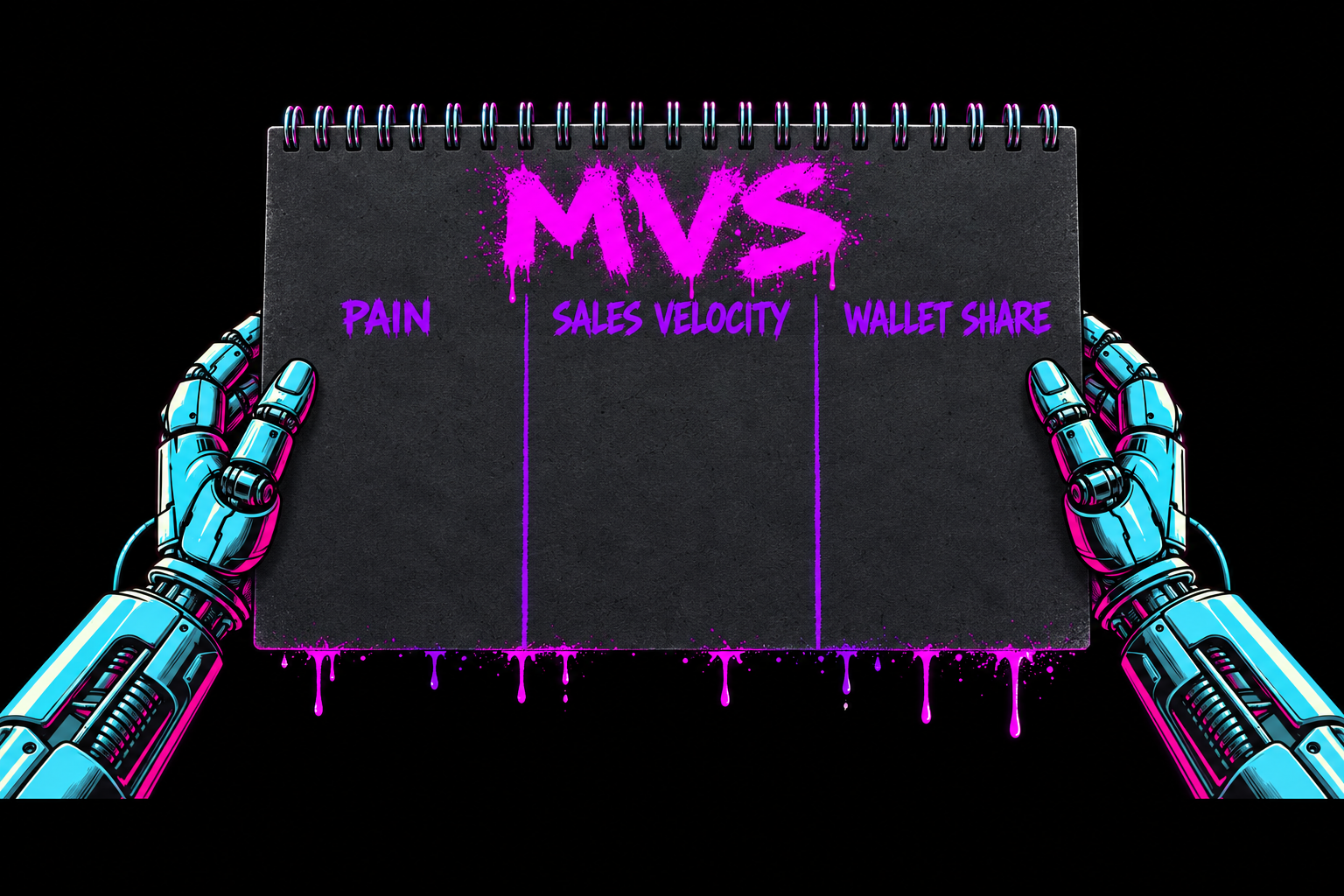
Your MVS™ is the one persona with the greatest pain, the fastest sales velocity, and the biggest wallet share.
Let’s break down what that actually means:
Pain
Your business exists to solve a problem. The question is how badly that problem actually hurts each persona.
In startups we talk about painkillers and vitamins.
A vitamin improves something incrementally and is not critical.
A painkiller takes the pain away.
You want to be the painkiller.
In sales they talk about a bleeding neck problem, a framing I first came across through Justin Welsh. It is graphic and, perhaps, that is why it’s so memorable.
Sales teams are taught to find a customer’s bleeding neck problem: a problem so severe that the customer will do almost anything to make it stop.
For me as a startup coach, that is a founder who has spent months, sometimes years, and often tens or hundreds of thousands of dollars, trying to validate a business and has come to me frustrated and depleted.
It is always better if they reach me before that point...
But I promise you: the sale is always easier if the pain is severe and already there.
Sales velocity
I learned this one the hard way with my first startup business.
I was selling to arts and culture organisations. I would nail the demo, get the green light, ask when we should start, and hear "next financial year would be great".
As a startup, I did not have until next financial year.
Sales velocity is how fast you can get from lead to sales call to contract to money in the bank.
Cash rules everything around me
C.R.E.A.M., get the money
Dollar, dollar bill, y'all
- The Wu-Tang Clan
This is why small fish are usually the better early target.
Enterprise customers have procurement cycles, multiple decision makers and legal review, and that can run for months. Smaller customers have less red tape and the decision maker is usually obvious, often the person you are already talking to.
It is also the second reason not to hunt whales early. You rarely have the runway to build something impressive enough to win them while surviving their buying process.
When you’re starting, the lowest friction sale is the deal you want to optimise for.
Wallet share
This is not how much money they have.
It is how much money they have for this specific problem.
And it all comes down to the specific budget bucket your product falls into.
How much they have, and how much they are willing to spend, are two very different things and founders confuse them constantly.
A business can be doing well, investing in growth, and still have nothing allocated to the department where you play. They might have $1 million for research and development and a $50,000 software budget.
Which is why the budget question so critically belongs in validation, and not in your pricing conversation six months later.
Here is what that is worth:
I have had clients positioned as software, competing for a slice of a $50,000 software budget line. With a healthy dose of customer discovery and validation, we implemented a reframe of what the product actually was. From vying for a slice of that small software bucket, they were able to take a large chunk from that $1 million research and development budget bucket instead.
Same business, same exact product, just positioned at a different, much more lucrative bucket.
Know how and where your customers spend their money, and try to position your product as the solution to the problem with the biggest budget bucket.
The honest constraint
You will rarely max all three.
The biggest wallet usually belongs to the slowest buyer, which is the whale problem again.
The fastest buyer often has the smallest budget.
MVS™ is an optimisation, not a checklist, and anyone selling you a version where all three land at once is selling you something.
Scoring it
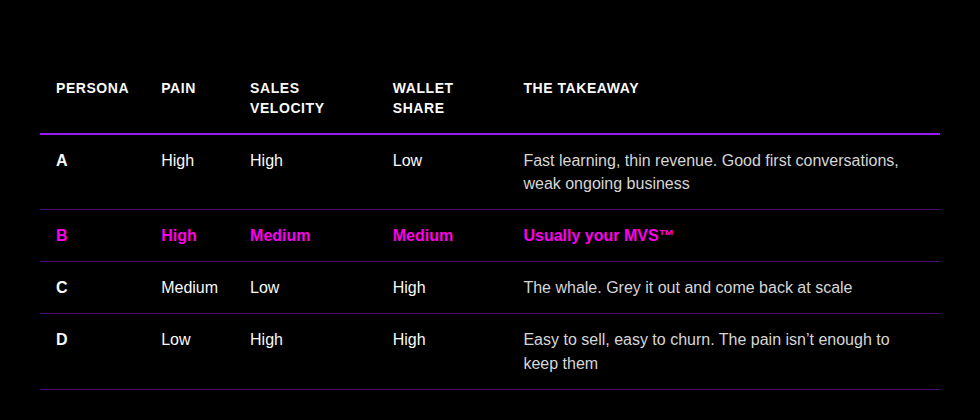
Score each persona high, medium or low on the three criteria.
There’s no need to total them. Just simply look at the shape:
<style>
.ops-mvs-wrap{overflow-x:auto;-webkit-overflow-scrolling:touch;margin:24px 0;}
.ops-mvs{width:100%;min-width:640px;border-collapse:collapse;font-family:inherit;font-size:16px;line-height:1.45;color:#FAFAFA;}
.ops-mvs th,.ops-mvs td{text-align:left;vertical-align:top;padding:14px 16px;border-bottom:1px solid rgba(154,25,249,0.45);}
.ops-mvs th{font-weight:700;color:#FAFAFA;border-bottom:2px solid #9A19F9;font-size:14px;letter-spacing:0.04em;text-transform:uppercase;}
.ops-mvs td:first-child{font-weight:700;}
.ops-mvs tr.ops-mvs-hit td{color:#FD00EA;font-weight:700;}
.ops-mvs td:last-child{color:#D6D6D6;}
.ops-mvs tr.ops-mvs-hit td:last-child{color:#FD00EA;}
</style>
<div class="ops-mvs-wrap">
<table class="ops-mvs">
<thead>
<tr><th>Persona</th><th>Pain</th><th>Sales velocity</th><th>Wallet share</th><th>The takeaway</th></tr>
</thead>
<tbody>
<tr><td>A</td><td>High</td><td>High</td><td>Low</td><td>Fast learning, thin revenue. Good first conversations, weak ongoing business</td></tr>
<tr class="ops-mvs-hit"><td>B</td><td>High</td><td>Medium</td><td>Medium</td><td>Usually your MVS™</td></tr>
<tr><td>C</td><td>Medium</td><td>Low</td><td>High</td><td>The whale. Grey it out and come back at scale</td></tr>
<tr><td>D</td><td>Low</td><td>High</td><td>High</td><td>Easy to sell, easy to churn. The pain isn’t enough to keep them</td></tr>
</tbody>
</table>
</div>Two critical rules:
- A low in the pain column disqualifies a persona no matter what the other two say.
Without significant pain, you are simply a vitamin. The result of that is a customer that will not use your product enough. Enough for their own value, enough for sufficient feedback, enough to consider referring you more business, and enough to not churn when that budget bucket gets low.
- Where two personas score the same, take the one you can reach fastest.
Access is a real advantage and most founders undervalue it. Founders hesitate tapping a contact because they don’t want to cash in social capital, or they see their rolodex as something that doesn’t scale. But the advice is the opposite. Now is the time to cash in your social capital, and doing things that don’t scale (hat tip to Paul Graham of Y Combinator) is exactly what you should be doing.
Once you have chosen who you think will be your Maximum Valuable Segment™, that persona is your target early adopter.
Your copy, positioning, pricing and brand should all be directed at them.
What that means is that when they land on your website, or see your brand, or read your copy, they should think: “this was built for me”.
Let me be more clear:
You do not need three different pricing tiers.
You do not need features that serve each persona.
If you’re going to market, the goal is not to serve everyone. It is to pick the one persona, the Maximum Valuable Segment™, most likely to generate the revenue that funds everything after it.
And here’s the part that most founders ignore because they think they know better…
Validation is the first stage of distribution
Founders think the order is build it, then sell it.
It is the other way round.
Validate, sell, then build what the market actually wants rather than what you assumed it wanted.
And here it is. The part that destroys every cognitive bias or self-assurance you use to tell yourself you don’t need to complete this task:
You are not only validating the customer. You are validating that you can reach them.
Validation is the first stage of distribution. It is the first real test of whether you can find and approach the people you intend to sell to. If you cannot find them now, before the product is finished, you will not suddenly be able to find them later.
Someone can build the best product in the world, and if they cannot get in front of a customer they are dead.
The half a million dollar validation conversation
Like many founders, I am a perfectionist.
With my first tech startup, I hesitated to reach out to customers.
The product wasn’t fully built, features were buggy, and I wanted to bring my A-game.
That is until I couldn’t wait anymore.
It’d been months in development and my runway was tightening.
And there was a little feeling in my stomach saying:
you’re building now but when it’s done, how do you know you can even close the deal?
When I couldn’t ignore that feeling anymore, I decided to knock up a deck, a dedicated landing page custom-made for the client, and sent out an email to one of the most lucrative customers I could sign: my MVS™.
To my delight, they replied and booked me in for a meeting with the General Manager, Graeme.
The meeting went really well.
Not because I spent most of it pitching my product, but because I spent most of it asking him questions and validating whether he had an actual pain point.
More importantly, we dug into actual process and procedure — who specifically was handling the problem, and what it looked like in terms of time and money.
That’s when he asked me something I will never forget.
“Kevin, if we gave you half a million dollars of investment, how far do you think you can take this?”
Graeme didn’t just want the solution. He wanted to help me take it to market, polish the product and capture the upside.
That’s when I knew I was truly onto something.
And more importantly, that I was a founder that could distribute and make the sale.
Reframing rejection
Working with first-time founders, my clients often tell me talking to customers is scary.
They do not want to get it wrong or offend anyone.
But honestly?
Something much deeper is going on there.
They do not want to be rejected.
They do not want to fail.
They do not want somebody to tell them their business is stupid.
I think that is the real concern, and it is understandable.
So let me reframe it.
When you find out a persona is not your customer, that is not heartbreak. That is a step closer to the one who is.
The tragedy is not being wrong. The tragedy is spending months or years building for a persona and a problem you invented, and never once going to check. That is what actually costs you.
Two last things to help you win:
- Pick a niche with enough people to burn.
Your first ten conversations will be worse than your next ten, so do not choose a market with only ten customers in it. Choose one big enough to get it wrong in.
With my first startup, Fiestafy, there were only so many major theatre venues in each city. Botch one demo and you might kill 25–50% of your supply in that market.
But with my next, Workyard, we helped builders find tradies. All I had to do was walk the street and I noticed a tradies’ ute on every corner. Knowing I could literally approach my customer on the street (and I did it often!), was enough for me to know this could be a huge business.
- You will never sign every customer.
This is business, not Pokémon, you cannot catch them all.
The biggest companies in the world do not win every customer and they have budgets neither of us will likely ever see.
The goal is not to avoid rejection. It is to expect it and learn from it.
Your takeaways for the week
- Write out your first three personas. Not one, not fifteen.
- Get specific enough to pass the coffee test.
- Name them with alliteration.
- Highlight every assumption yellow and every verified fact green.
- Score them on pain, sales velocity and wallet share, and pick your MVS™.
- Use the yellow to determine the key areas that are unknown.
- Then go and find out which of the yellow is actually true.
- Don't have one conversation. Aim for five this week, and 20 to 50 before you call anything validated.
And an important reminder: if you cannot get in front of your customers now, you will not suddenly be able to when the product is built.
Enjoyed this?
Sign up to our newsletter and you’ll be notified when I release a new playbook, guide or prompt.
Want to work with Kev? Apply here.


Latest Articles
Explore our latest articles for fresh perspectives, expert reviews, and practical tips on everything tech. Stay updated, dive deep, and discover new ideas—Relay brings the digital world to your fingertips.